
Nerd Out With US
The Power of HOCl: A Little Science, A Whole Lot of Good.
The ingredient you may have never heard of, but might just become your new favorite.
You read the labels. You question the ingredients. You care about what touches your baby's skin, the toys they put in their mouths, and the surfaces they explore.
We get it. We're parents, too.
When we created Lulifi, we weren't looking to add another product to an already overwhelming world of family care. We wanted to simplify it.
That's when we fell in love with the science behind hypochlorous acid, better known as HOCl.
And while it might sound like something straight out of a chemistry textbook, the science behind it is surprisingly simple.
What exactly is HOCl?
HOCl stands for hypochlorous acid, a powerful yet surprisingly simple molecule with a fascinating history.
It's not a new invention or the latest cleaning trend. HOCl has been studied for decades for its antimicrobial properties and its potential applications in cleaning, skin care, and wound care.
In fact, researchers have documented its ability to act against a broad range of microorganisms, including bacteria, viruses, and fungi, under appropriate conditions.
But here's the part we love most: the process of making HOCl doesn't require a lengthy list of complicated ingredients.
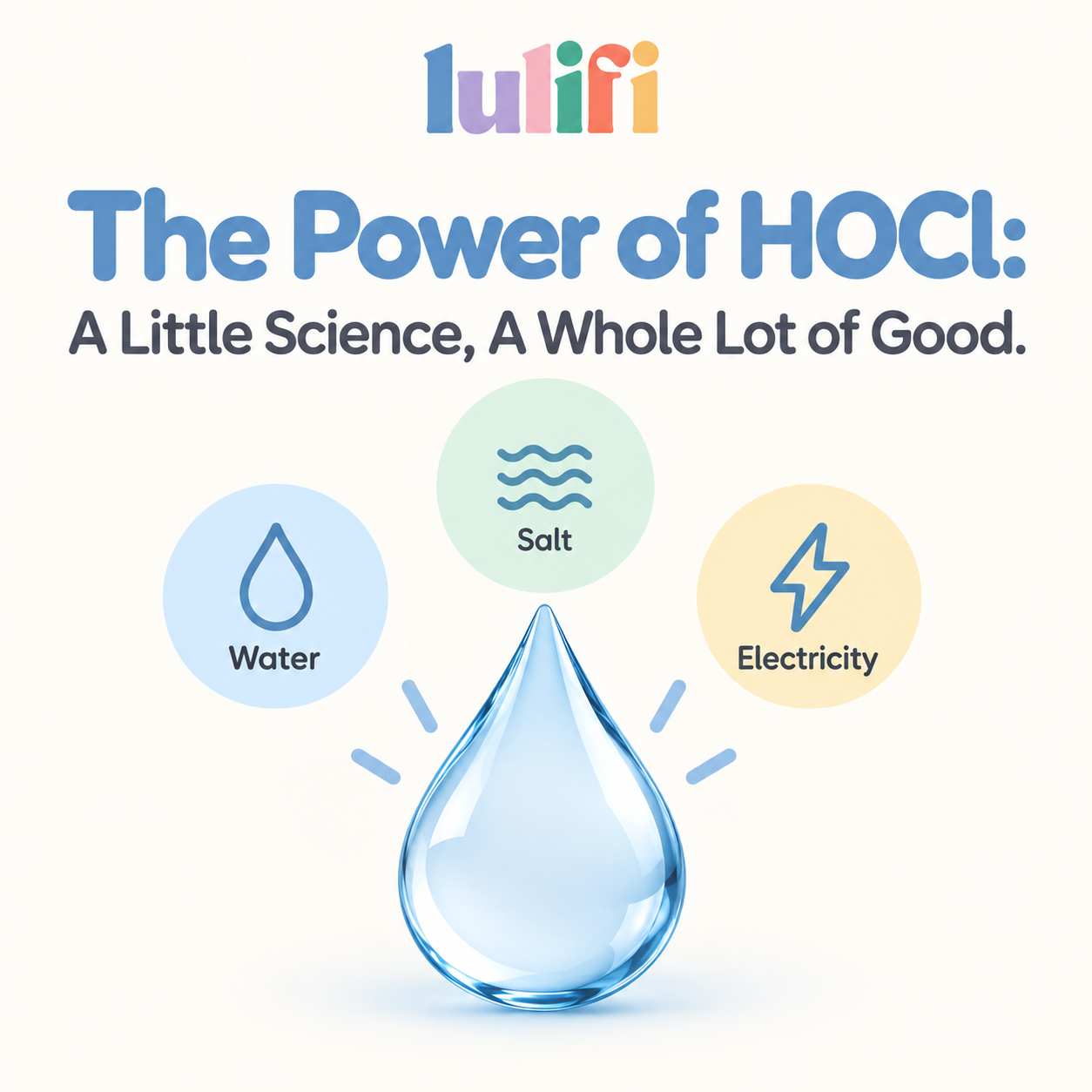
Water + Salt + Electricity = HOCl
Through a process called electrolysis, an electrical current passes through a saltwater solution, producing hypochlorous acid.
A little chemistry. A whole lot of potential.
The process may be simple, but the chemistry behind it is what makes HOCl so interesting.
Scientific research has explored how electrochemically produced HOCl can be used in antimicrobial applications and how its effectiveness depends on the properties of the finished solution.
So, what makes HOCl so powerful?
HOCl is an oxidizing agent.
In everyday terms, that means it can react with important components of microorganisms, including proteins and cell membranes, disrupting their ability to function.
Scientists have studied this activity extensively, helping explain why HOCl has applications across surface disinfection, skin care, and clinical settings.
What makes it especially interesting to us is the opportunity to bring this science into products designed for everyday family life.
Because when you have little ones, cleaning isn't just about making the kitchen look pretty.
It's about the toys that somehow always end up in their mouths. The high chair after another very enthusiastic spaghetti dinner. The little hands touching absolutely everything.
And all the everyday moments in between.
We believe family care should be thoughtful enough for all of it.
Not all HOCl is created equal. Here's why that matters.
One of the biggest misconceptions about HOCl is that every solution is essentially the same.
It's not quite that simple.
The concentration, pH, stability, and intended application all influence how a finished HOCl product performs.
Concentration matters.
HOCl solutions can be formulated at different concentrations, commonly expressed in parts per million, or PPM.
A higher number doesn't automatically mean a better product for every application. Concentration needs to be considered alongside contact time, pH, and what the product is intended to do.
pH matters.
The pH of a solution influences how much of its available chlorine exists as hypochlorous acid rather than other chlorine species.
That balance can affect its antimicrobial activity and other formulation properties.
Stability matters.
HOCl can be sensitive to environmental conditions, including heat, light, and storage.
Maintaining the intended properties of the solution over its shelf life is an important part of formulation.
These are not just marketing details. They are documented considerations in the scientific literature on HOCl.
At Lulifi, we believe the details matter.
That's why we're intentional about formulating our products for their intended uses, rather than treating every HOCl application as one size fits all.
Beyond cleaning: HOCl and skin care
Here's where the science gets even more interesting.
HOCl isn't limited to household cleaning applications.
Researchers have also investigated appropriately formulated HOCl solutions for topical skin care and wound cleansing.
A 2018 review published in the Journal of Clinical and Aesthetic Dermatology examined HOCl's antimicrobial and anti-inflammatory properties, along with research involving certain skin conditions and wound care applications.
Other clinical literature has discussed its potential in wound care and dermatologic procedures.
These findings help explain why HOCl has attracted attention in both skin care and clinical settings.
Of course, the formulation matters. A solution intended for household surfaces should not automatically be considered appropriate for skin, and clinical research on one HOCl formulation doesn't establish the same results for every product containing the ingredient.
For us, that's another reason to be intentional about creating products for specific purposes.
Why we chose HOCl for Lulifi
We're parents first.
We know what it's like to question the products you're bringing into your home. To read the back of a bottle and wonder whether you really need everything on that ingredient list.
We wanted to create family care that felt simpler.
Products that fit into real routines, from cleaning the toys scattered across the living room to caring for the skin that needs a little extra attention.
HOCl gave us an ingredient with an established scientific foundation and the versatility to explore those everyday needs.
But our mission has always been bigger than one ingredient.
It's about making thoughtful family care feel accessible. Creating products with intention. And giving parents a little more confidence in the everyday choices they make for their families.
Because you're right to care this much.
And we do, too.
A better kind of everyday care.
The more we learned about HOCl, the more we knew we wanted to share it.
Not because it's a trendy ingredient.
Not because it has a complicated scientific name.
But because its chemistry offers exciting possibilities for thoughtfully formulated family care.
And we believe parents deserve to understand the science behind the products they choose.
From our family to yours, welcome to a more thoughtful way to care for the things you love most.
Less unnecessary stuff. More thoughtful science. A whole lot of love.
That's the Lulifi way. 💛
Nerd out with us. 🔬
Want to dig a little deeper? We love a mom who does her research.
Here are some scientific publications behind the HOCl information we've shared.
1. Antimicrobial efficacy, mode of action and in vivo use of hypochlorous acid
A scientific review examining how HOCl works against microorganisms and its potential applications.
Published in GMS Hygiene and Infection Control, 2023.
https://pmc.ncbi.nlm.nih.gov/articles/PMC10073986/
2. Hypochlorous Acid: A Review
Explores HOCl production, antimicrobial activity, stability, concentration, and disinfection applications.
Available through the National Library of Medicine, 2020.
https://pmc.ncbi.nlm.nih.gov/articles/PMC7315945/
3. Status Report on Topical Hypochlorous Acid
Examines HOCl's potential in skin care, the importance of formulation stability, and research on topical applications.
Published in the Journal of Clinical and Aesthetic Dermatology, 2018.
https://pmc.ncbi.nlm.nih.gov/articles/PMC6303114/
4. Expert Recommendations for the Use of Hypochlorous Solution: Science and Clinical Application
A literature-based expert review discussing HOCl's antimicrobial properties, safety, and clinical applications.
Indexed by the National Library of Medicine, 2017.
https://pubmed.ncbi.nlm.nih.gov/28692424/